
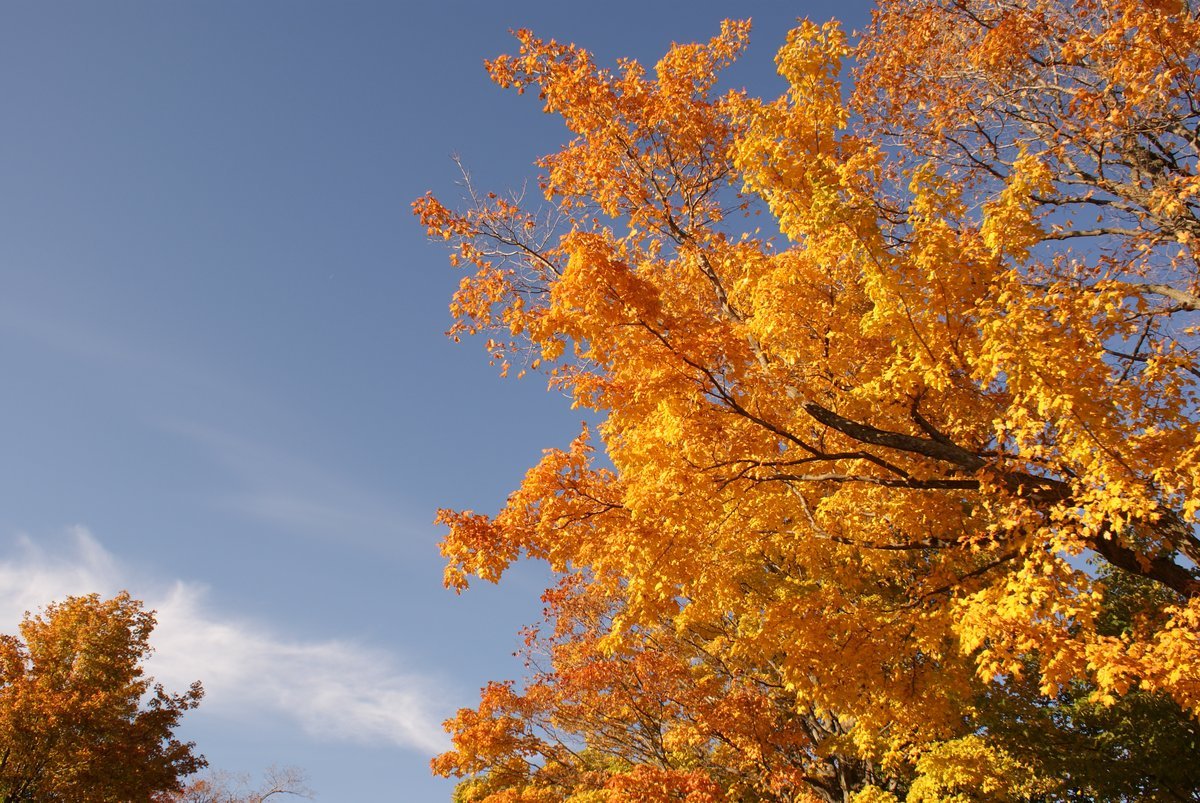
Autumn is the most colourful season for tree identification, and also one of the most useful. As days shorten and nights cool, leaves change colour in patterns that are often characteristic of the species, and fallen leaves gather on the ground where they can be picked up, compared and photographed at leisure.
Autumn identification is not only about colour. The order in which trees change, the way leaves fall, the fruit and seeds left on the branches, and the shape of the tree once the leaves are gone all add information.
Why Leaves Change Colour
Leaves are green in summer because of chlorophyll, the pigment that captures sunlight for photosynthesis. As autumn approaches, the tree stops making chlorophyll and the green fades, revealing other pigments that were there all along: yellow carotenoids and orange pigments that give birches, beeches and hickories their golden colour.
Because the mix of pigments differs between species, autumn colour is often a reliable clue. Maples are famous for reds and oranges, birches and poplars turn a clear yellow, oaks turn russet, brown or red, and beeches turn a warm copper.
Reading Colour and Timing
Different species change colour at different times, and this timing is itself a clue. In most temperate regions, birches and cherries colour early, often in September, while oaks and beeches hold their green leaves much longer and may still be coloured in November. If you visit the same park or woodland every week through autumn, you will see a sequence of colour that repeats each year, and you can use it to predict which trees will change next.
Look at how the colour spreads across a single tree. Some trees colour evenly, while others colour first on the outer branches or on the sunny side. A tree that turns colour on one side only may be responding to sun, wind or root damage rather than the season. Note the date and the weather, since a warm, wet autumn can delay colour, while a cold snap can bring it on suddenly. A dated photograph of a tree in full colour is a useful record for future years.
Fallen Leaves on the Ground
Once leaves fall, identification becomes easier in some ways, because you can pick up a leaf, turn it over, and compare it with others without craning your neck. Fallen leaves keep their shape, size and edge, even when their colour has changed, so a fallen oak leaf with its lobes is still clearly an oak leaf, and a fallen maple leaf is still clearly a maple leaf. Gather a few leaves from beneath a tree and compare them with a guide.
Fallen leaves also tell you about the tree above. A thick carpet of small leaves suggests a birch or a willow, while a scattering of large leaves suggests an oak, a maple or a plane tree. Look at the leaf stalks too: some leaves fall with long stalks, others drop the blade and leave the stalk behind. If you are unsure which tree a fallen leaf came from, look straight up: the tree above is usually the source, and its bark and remaining leaves can confirm the match.
Five Steps for Autumn Identification
Use this routine on an autumn walk to identify trees by their seasonal clues. It works best if you visit the same trees more than once through the season.
- Note the colour and the date. Record the main colour of the tree and when you saw it, since timing is part of the clue.
- Pick up fallen leaves. Check their shape, size and edge, and photograph them against a plain background.
- Look for fruit and seeds. Acorns, nuts, cones and winged seeds are often still on the tree or on the ground in autumn.
- Check the bark and the shape. As leaves fall, the trunk and branches become visible, so note the bark pattern and crown shape.
- Visit again in a week. Colour changes fast in autumn, and a second visit often confirms an identification.
Autumn Fruit and Seeds
- Acorns: oaks, with the cup shape helping to narrow down the species.
- Conkers: horse chestnuts, in spiky green husks that split open in autumn.
- Beech mast: small, triangular nuts in spiky husks, found under beech trees.
- Hazelnuts: round nuts in a leafy cup, often with signs of squirrel feeding.
Common Mistakes to Avoid
- Identifying from colour alone. The same species can show different colours in different years and places, so check leaf shape and fruit too.
- Forgetting that weather changes colour. A warm, cloudy autumn gives duller colours, while sunny, cool nights give brighter reds.
- Assuming a fallen leaf came from the nearest tree. Wind can carry leaves a long way, so look up and check the tree above.
- Ignoring the order of change. The sequence in which trees colour is a useful clue that a single visit can miss.
- Waiting too long. Colour peaks for only a week or two on many trees, so visit often in autumn.
Frequently Asked Questions
Why do some trees turn red and others yellow in autumn?
Yellow comes from pigments that are present in the leaf all summer and are revealed when green chlorophyll fades. Red comes from anthocyanins, which the tree makes in autumn, especially in sunny, cool weather.
Can I identify a tree from a fallen leaf?
Yes, often. A fallen leaf keeps its shape, size and edge, which are the main identification features.
When is the best time to see autumn colour?
It depends on the region and the year, but in most temperate areas the peak comes over a few weeks in mid-autumn. Early colouring species peak first, followed by later species such as oaks and beeches.
Do all trees change colour in autumn?
No. Evergreen trees keep their leaves through winter, although they shed some older needles each year.
Autumn gives you colour, fallen leaves and fruit all at once, and a few weekly walks can teach you more than a whole summer of study. Collect leaves, note the dates, and compare your finds year after year. For more seasonal help, read our guide to identifying trees by season and how to identify a tree by its leaves, and use the tree identifier to check any tree from a photograph of its leaves or fruit.
Featured image: Wikimedia Commons (CC / public domain).