
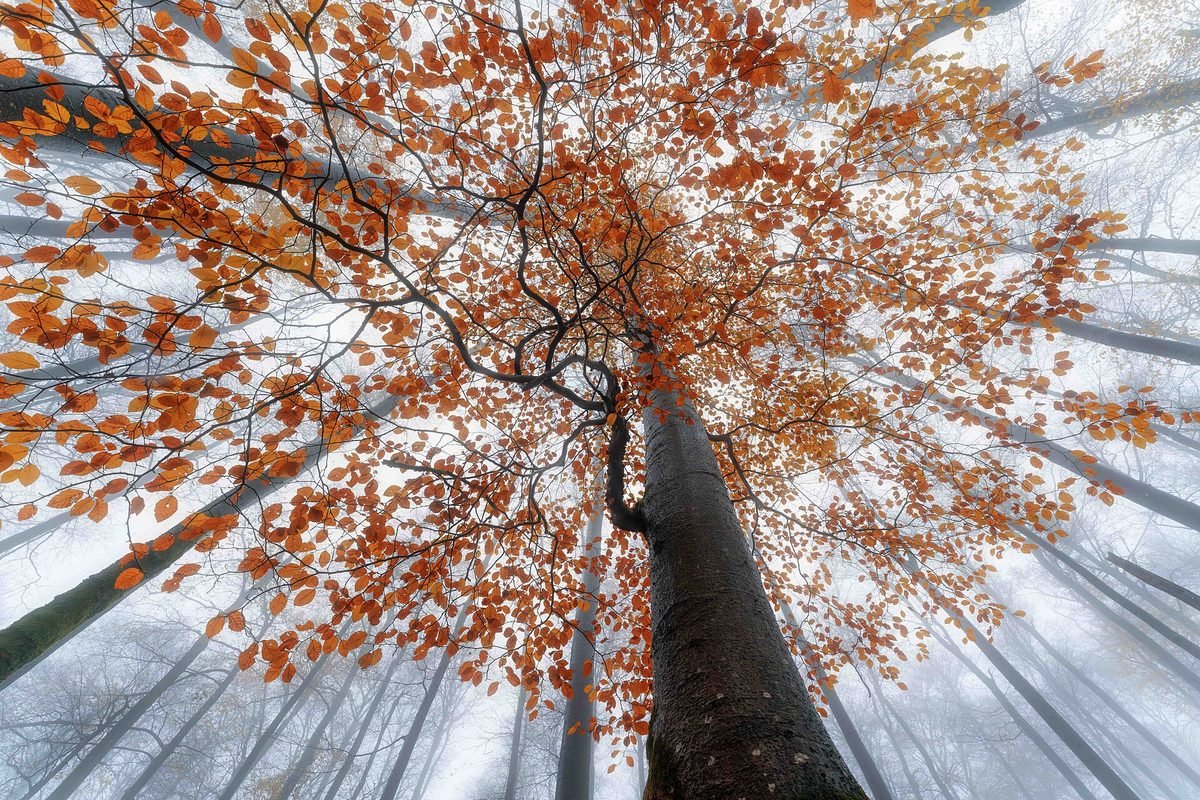
Walk through a wood in winter and the difference is obvious. Some trees stand bare, their branches empty against the sky, while others stay green and full of leaves. The bare ones are deciduous trees, which shed all their leaves in autumn and grow new ones in spring. The green ones are evergreens, which keep their leaves through winter and replace them gradually, a few at a time.
This split is one of the most useful facts in tree identification, because it divides the tree world into two large groups. It also tells a story about survival: deciduous trees avoid the cost of keeping leaves through cold, dry winters, while evergreens pay that cost in exchange for being able to photosynthesise whenever conditions allow. Both strategies work, which is why both kinds of tree are common.
How Deciduous and Evergreen Trees Differ
Deciduous trees grow broad, thin leaves in spring, use them hard through summer, then shed them in autumn. Before a leaf falls, the tree pulls valuable nutrients such as nitrogen back into its branches and stores them for next year. The leaf then changes colour as chlorophyll breaks down, revealing yellows, oranges and reds, before a weak layer forms at the stalk and the leaf drops. This annual reset costs energy, but it frees the tree from maintaining leaves through freezing weather.
Evergreen trees take the opposite approach. Their leaves are usually narrow needles or tough, waxy scales that lose little water and resist frost. A pine needle can live for three to five years, and the tree replaces only a fraction of its needles each year, so it always looks green. This steady strategy lets evergreens photosynthesise on mild winter days and survive in cold, dry or nutrient-poor soils where growing a whole new canopy each spring would be too expensive.
The two strategies suit different climates. Deciduous trees dominate temperate regions with warm summers and cold winters, where a big leafy canopy pays off in summer and shedding saves the tree in winter. Evergreens dominate far northern forests, high mountains and poor soils, where the growing season is short and keeping leaves is cheaper than regrowing them. In mild climates, such as the Mediterranean, broadleaf evergreens like holly and olive also thrive.
How to Identify It Step by Step
- Visit the same tree in summer and again in winter, and note whether it keeps its leaves or stands bare.
- Look at the leaf shape: broad flat leaves usually belong to deciduous trees, while needles or scales suggest an evergreen.
- Check the ground in autumn for a carpet of fallen leaves, which is a strong sign of a deciduous tree.
- Feel the leaf: thin and soft suggests deciduous, while thick, waxy or needle-like suggests evergreen.
- Photograph the tree with the Tree Identifier in both seasons, and compare the leaf and shape clues to confirm the group.
Deciduous and Evergreen Examples
- Oak: A classic deciduous tree with broad lobed leaves that turn brown and gold in autumn before falling in winter.
- Scots pine: A hardy evergreen with paired needles that stay green all year and are shed gradually, never all at once.
- Maple: A deciduous tree famous for bright autumn colour, with broad leaves that fall after a spectacular display of red and orange.
- Holly: A broadleaf evergreen with tough, spiny, glossy leaves that stay green through winter and carry red berries.
- Larch: A surprising exception: a conifer that is deciduous, shedding its soft needles in autumn and regrowing them in spring.
Common Mistakes to Avoid
- Thinking all conifers are evergreen. Larch, dawn redwood and swamp cypress are conifers that shed their leaves or needles in autumn.
- Assuming all broadleaf trees are deciduous. Holly, olive and live oak keep broad leaves all year and are true evergreens.
- Calling a tree dead in winter. A bare deciduous tree is dormant, not dead, and its buds are already waiting for spring.
- Judging by one visit in summer. In summer both groups look green, so the difference only becomes clear in autumn and winter.
Which Strategy Wins, and Where
Neither strategy is better in general; each wins in the climate it suits. In a temperate wood, a deciduous oak grows faster than a pine because its broad leaves capture more sunlight in summer, even though it must regrow them each spring. In the far north, a spruce grows where an oak could not, because its needles survive long frozen winters and can photosynthesise during brief mild spells. Climate change is now shifting this balance, with evergreens spreading in some warming regions and deciduous trees moving north.
For the tree identifier, this difference is a powerful first filter. If you see a tree in full leaf in midwinter, you can rule out most deciduous species at once and focus on evergreens. If you see a bare tree in January, it is almost certainly deciduous, and the buds, bark and shape become your best clues. Knowing which group a tree belongs to can cut the list of candidates in half before you even look at a leaf.
Frequently Asked Questions
What is the difference between deciduous and evergreen trees?
Deciduous trees shed all their leaves in autumn and regrow them in spring, while evergreens keep their leaves all year and replace them gradually.
Are all conifers evergreen?
No. Most are, but larch, dawn redwood and swamp cypress are deciduous conifers that shed their needles in autumn.
Why do deciduous trees lose their leaves?
Shedding leaves saves water and energy in winter, when frozen soil makes water hard to absorb and broad leaves would be damaged by frost.
Do evergreen trees ever shed leaves?
Yes, but gradually. A pine needle lives for several years, and the tree drops only a fraction of its needles each year, so it always looks green.
Try it yourself: upload a photo to the Tree Identifier and see the identification with full details on this site. Read also: Identify Trees by Season: Spring, Summer, Autumn.
Deciduous and evergreen trees solve the same problem in opposite ways: one sheds its leaves and starts fresh each spring, the other keeps tough leaves and works all year. Learn to spot the difference in winter, and you will have a fast first step for identifying almost any tree you meet.