
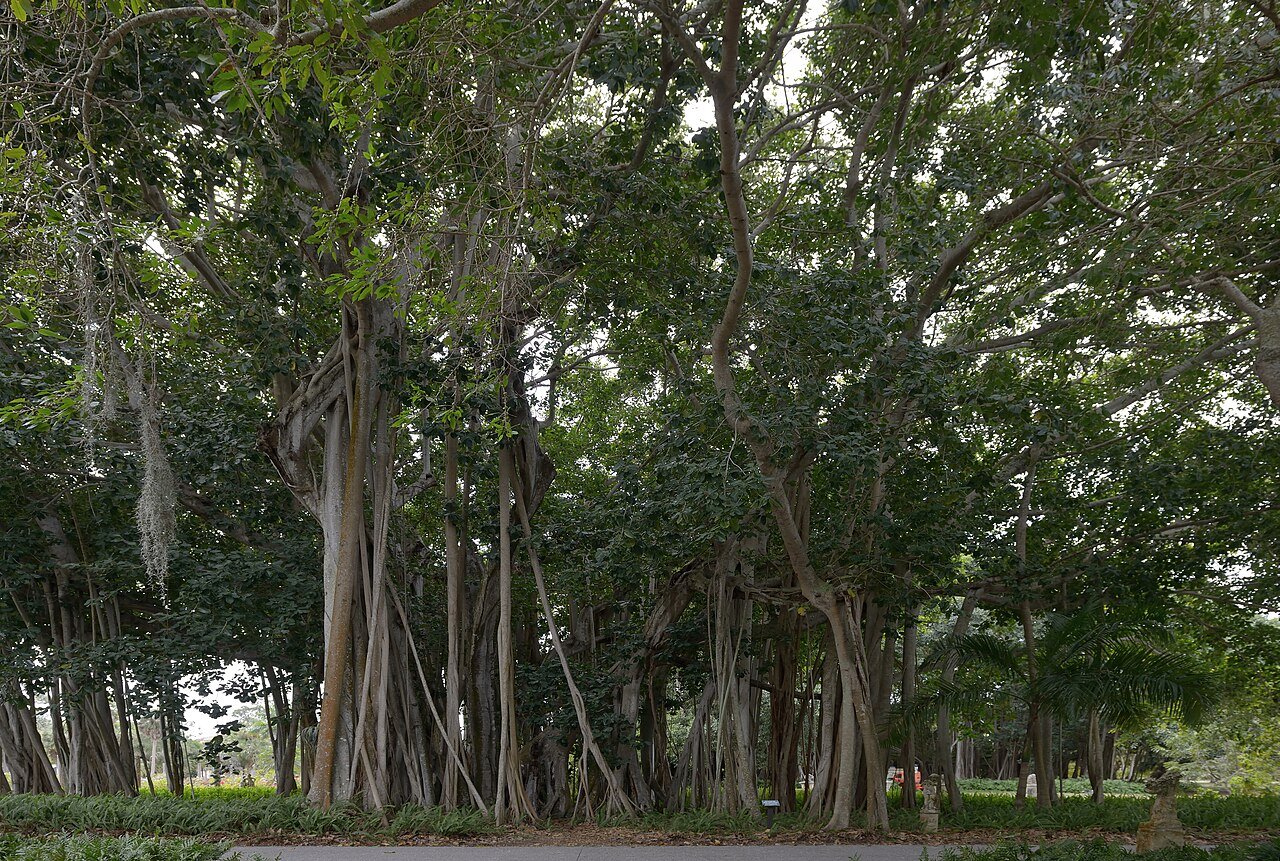
The banyan is the most spectacular tree most people will ever stand under. A single old banyan can cover more ground than a village square, with a canopy held up by dozens of trunks that all began as roots hanging in the air. It is the national tree of India, a sacred tree in many traditions, and a landmark wherever it grows.
Identifying a banyan is usually easy, because no other common tree grows the same way. This guide explains the aerial roots, the leaves, the figs and the sheer size that give a banyan away, and how to tell it apart from its close relative, the peepal.
Banyan Tree Features to Check
The aerial roots are the feature no other common tree shares. A banyan sends roots down from its branches, and when they reach the ground they thicken into new trunks that support the spreading crown. An old tree can have tens or even hundreds of these prop trunks, and the whole structure can cover a hectare or more. If you see a tree that looks like a small forest held up by many trunks, it is a banyan.
The leaves are large, leathery and oval, 10 to 20 centimetres long, dark green and glossy above, with a smooth margin and a short pointed tip. They grow in clusters at the ends of the branches, and they are thick enough to feel almost like plastic. Young leaves are often covered in fine soft hairs and have a reddish tint before they turn green.
The fruit is a small fig, about 1 to 2 centimetres across, green at first and turning red or orange when ripe. The figs grow in pairs in the leaf axils, and they are eaten by birds and bats, which spread the seeds. The bark is smooth and grey on young branches, becoming rougher and darker with age, and the trunk often shows the scars where aerial roots began.
How to Identify It Step by Step
- Look for aerial roots hanging from the branches, or thick prop trunks that were once roots. This is the decisive feature.
- Check the leaves: large, leathery, oval, 10 to 20 centimetres long, dark green and glossy, with a smooth margin.
- Look for the fruit: small figs in pairs, green turning red, about 1 to 2 centimetres across.
- Step back and look at the size: a mature banyan has a vast spreading crown supported by many trunks, unlike any other single tree.
- Upload a leaf or whole-tree photo to the Tree Identifier to confirm, and compare the leaf size with the description above.
Banyan and Its Relatives
- Peepal: also a fig, but with heart-shaped leaves with a long pointed tip, and no massive prop-root system like a banyan.
- Rubber fig: has similar large glossy leaves but grows as a single-trunk tree, often indoors, without aerial prop roots.
- Cluster fig: has figs growing in clusters on the trunk itself, and smaller leaves than the banyan.
- Indian laurel fig: a popular street tree with similar leaves, but it stays a single-trunk tree and never builds a banyan's forest of trunks.
Common Mistakes to Avoid
- Calling any large fig tree a banyan. Several figs have large leaves; only the banyan builds its famous forest of prop trunks.
- Expecting aerial roots on a young banyan. Young trees may have only one or two hanging roots, and the great prop system takes decades to develop.
- Confusing banyan leaves with peepal leaves. Banyan leaves are oval with a short tip; peepal leaves are heart-shaped with a long, drawn-out tip.
- Underestimating the size. A banyan's crown can be wider than a football field, so photograph the whole tree from a distance as well as the leaves.
How a Banyan Becomes a Forest
A banyan begins life as a tiny seed, often dropped by a bird into the fork of another tree. It grows downwards as well as upwards, sending roots to the ground while its crown spreads over its host. As the aerial roots thicken into trunks, the banyan becomes independent, and over a century it can cover an area larger than many parks. The Great Banyan in India is famous for covering more than a hectare with thousands of prop roots, and it is still growing.
That long life makes old banyans landmarks and meeting places, and it is why they are protected in many places. A banyan you identify today may still be standing, and still growing, a hundred years from now.
Frequently Asked Questions
How do I identify a banyan tree?
Look for aerial roots that become new trunks, large leathery oval leaves, small red figs in pairs, and a huge spreading crown supported by many trunks.
What is the scientific name of the banyan tree?
Ficus benghalensis. It belongs to the fig family, Moraceae, and is native to the Indian subcontinent.
How big can a banyan tree grow?
A mature banyan can spread over a hectare, with a crown 100 metres or more across and hundreds of prop trunks.
What is the difference between a banyan and a peepal tree?
Banyan leaves are oval with a short tip and the tree builds prop trunks; peepal leaves are heart-shaped with a long pointed tip and the tree stays single-trunked.
Try it yourself: upload a photo to the Tree Identifier and see the identification with full details on this site. Read also: Peepal Tree Identification Guide.
The banyan gives itself away: no other tree builds a forest from its own roots. Learn the aerial roots, the large leathery leaves and the small red figs, and you will recognise a banyan at any age — from a young sapling with one hanging root to an ancient giant holding up its own green roof.