
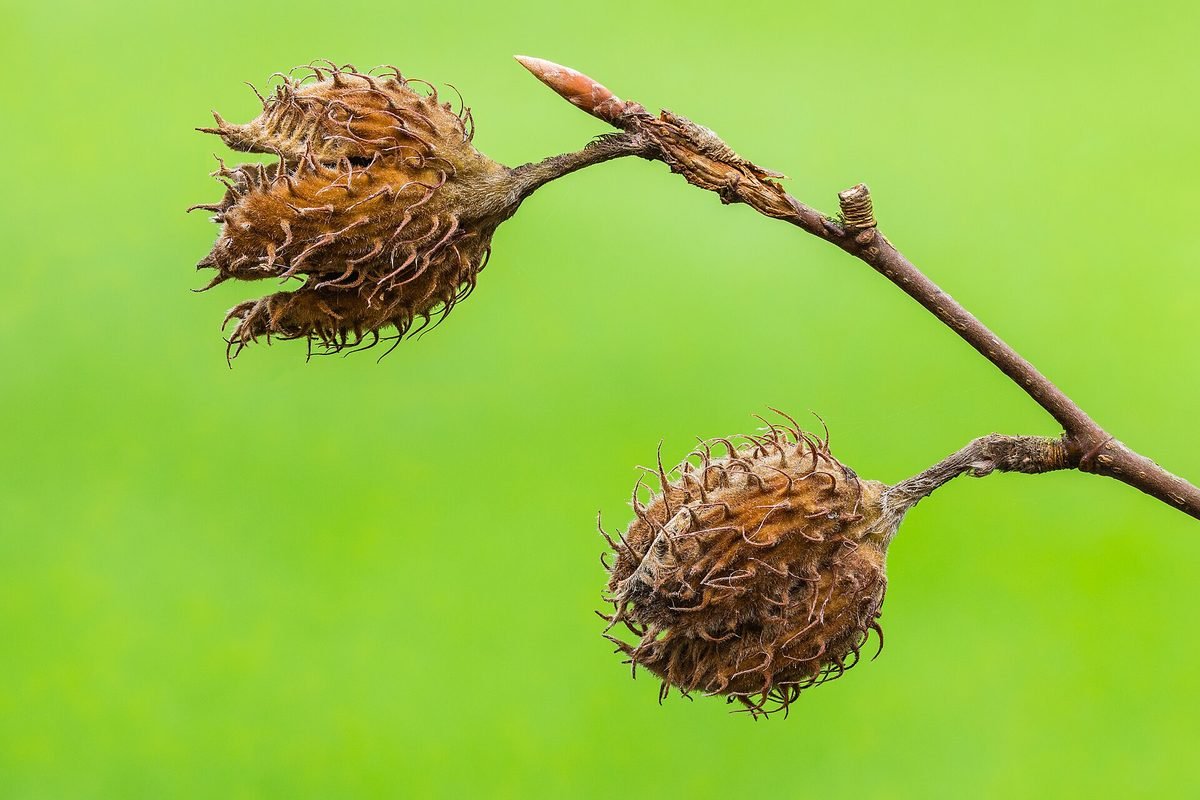
The European beech, Fagus sylvatica, is a tree of tall, cool woodland, and it is identified most easily by its bark. Beech bark stays smooth and pale grey for the whole life of the tree, even on trunks a metre across, which is unusual among large trees. Add oval leaves with wavy edges and small spiky cases that hold the nuts, and you have a set of clues that is hard to mistake.
Beech is also a tree of shade and seasons. Its dense canopy casts deep shade in summer, its leaves turn copper and gold in autumn, and many leaves stay on young trees through winter, rustling in the wind. This guide explains the bark, leaves, buds and mast, and how to use them in every season.
Beech Tree Features to Check
Start with the bark, the most distinctive beech feature. Beech bark is smooth, thin and pale grey, almost like the skin of an elephant, and it stays smooth even on very old and very large trees. It rarely cracks or flakes, and it often carries dark marks where branches were lost, as well as pale patches of lichen. If you see a large tree with completely smooth grey bark, beech should be high on your list, because few other large trees keep bark this smooth.
Next look at the leaves, which are simple, oval, 5 to 10 centimetres long, with a pointed tip and a wavy margin that is finely fringed with soft hairs when young. The leaves are glossy dark green above and paler below, with veins that run in straight parallel lines from the midrib to the edge. In spring the young leaves are soft, pale green and fringed with silk, in summer they are dark and glossy, and in autumn they turn copper, gold and russet before they fall.
The buds and mast complete the picture. Beech buds are long, slender and pointed, like small brown cigars, and they sit alternately along the twig, often at a slight angle. The fruit is called mast: small triangular nuts in pairs, held inside a woody case covered in soft spines that splits into four parts when ripe. Fallen mast and empty cases on the woodland floor are a strong clue in autumn.
How to Identify It Step by Step
- Look at the trunk first. Note the smooth pale grey bark that stays smooth even on a large old tree, with few cracks or flakes.
- Pick one mature leaf and check its shape: oval, pointed, with a wavy margin, glossy above, and veins that run in straight lines to the edge.
- Photograph the leaf flat on a plain light background in daylight, and take a second photo of the smooth bark filling the frame.
- Look for the buds in winter: long, slender, pointed and brown, sitting alternately along the twig at a slight angle.
- Upload the leaf or bark photo to the Tree Identifier, read the suggested species, then compare the buds or fallen mast before you decide the identification is correct.
Beech and Trees That Look Like It
- European beech: Fagus sylvatica, with smooth grey bark, wavy-edged leaves, long pointed buds and spiky cases holding paired nuts.
- American beech: Fagus grandifolia, similar to European beech but with leaves that have more sharply toothed edges and smoother, bluer grey bark.
- Copper beech: a purple-leaved form of European beech, planted in parks and gardens, with the same smooth bark and leaf shape in deep purple.
- Hornbeam: often confused with beech, but hornbeam bark is fluted and grey, and its leaves have deeply toothed edges with strong parallel veins.
- Sweet chestnut: has longer, more sharply toothed leaves and deeply fissured bark, and its spiky cases hold larger nuts than beech mast.
Common Mistakes to Avoid
- Confusing beech with hornbeam, which grows in similar woods. Hornbeam bark is fluted and ridged, while beech bark is completely smooth.
- Expecting beech leaves to fall in autumn on every tree. Young beech often keeps its dead copper leaves through winter, which is normal for the species.
- Judging by leaf colour alone. Beech leaves change from pale green to dark green to copper through the year, and colour is a weak clue on its own.
- Overlooking the buds. Beech buds are long, slender and pointed, and they are one of the best winter clues when the leaves have gone.
Beech Woodland and the Seasons
Beech woodland has a character of its own. The dense summer canopy casts such deep shade that few plants grow beneath a mature beech, and the woodland floor is often covered in a thick layer of fallen leaves and empty mast cases. In autumn the canopy turns copper and gold, and in a good mast year the ground is thick with triangular nuts that feed birds, squirrels and wild pigs. Those mast years come in cycles, with heavy crops every few years followed by light ones.
Beech is a long-lived tree that can reach 40 metres and live for 200 years or more, and it grows best in cool, moist, well-drained soil on chalk and limestone. Its smooth bark, its shade and its seasonal colour make it a favourite of walkers and photographers, and once you have learned its bark, you will recognise a beech wood from the edge of the field.
Frequently Asked Questions
How do I identify a beech tree in winter?
Use the bark and buds. Smooth pale grey bark that never cracks, plus long slender pointed brown buds, identifies beech with no leaves.
What is the scientific name of the European beech?
Fagus sylvatica. It belongs to the beech family, Fagaceae, and is native to Europe.
What is beech mast?
Beech mast is the fruit of the beech: small triangular nuts in pairs inside a spiky woody case that splits open when ripe in autumn.
How tall does a beech tree grow?
European beech usually reaches 25 to 40 metres, with a tall straight trunk and a broad dense crown.
Try it yourself: upload a photo to the Tree Identifier and see the identification with full details on this site. Read also: Identify a Tree by Its Bark.
Beech is a tree you can name from its bark alone: smooth, pale grey and unchanging even on an old tree. Add the wavy-edged leaves, the long pointed buds and the spiky mast cases, and the identification becomes certain in any season of the year.