
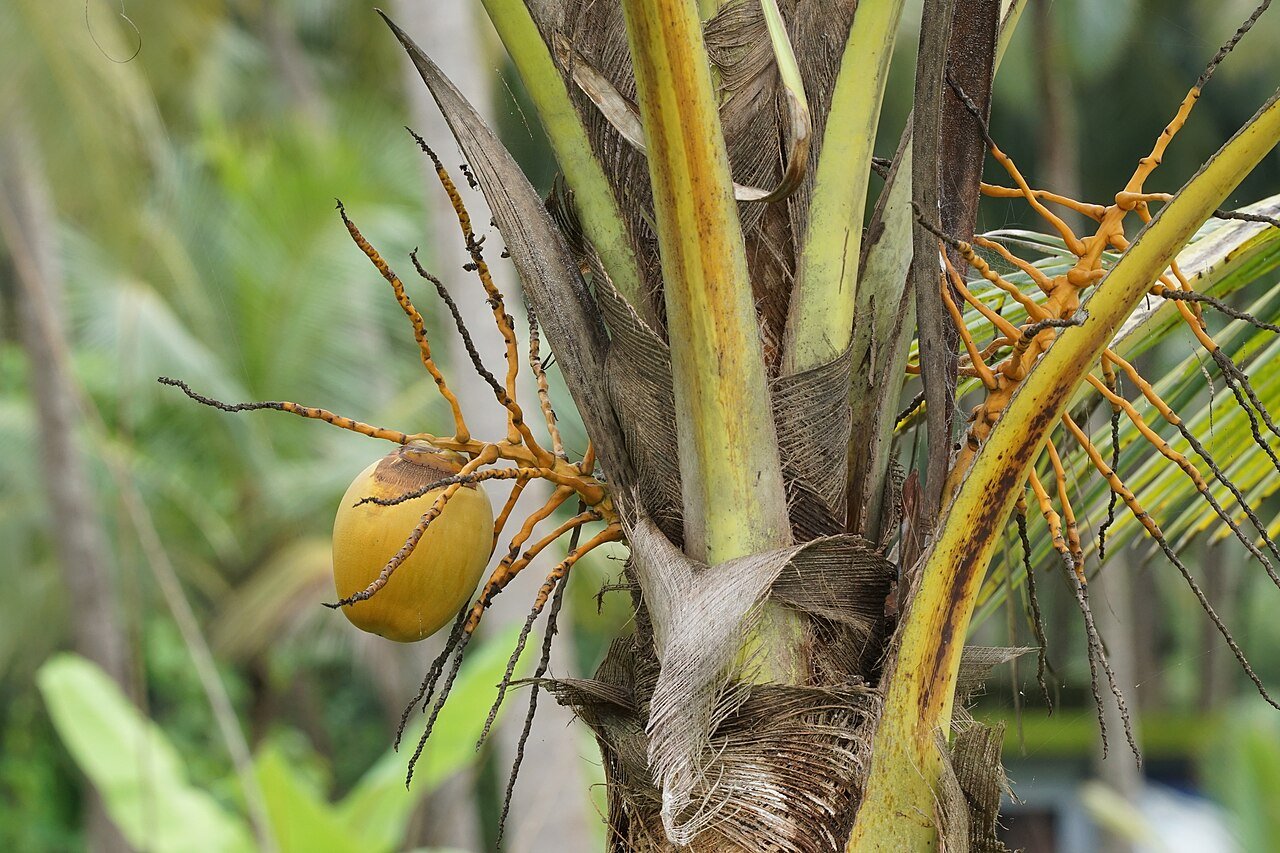
The coconut palm is the tree of tropical beaches, and it is one of the most useful trees in the world. Its fruit gives food, drink, oil and fibre, its leaves give thatch and mats, and its trunk gives timber. It is also one of the easiest palms to identify, because its fruit is the largest of any palm and its trunk often leans gracefully towards the sea.
This guide explains the trunk, fronds, flowers and fruit of the coconut palm, how it grows, and how to tell it apart from other palms — especially the date palm, which is its closest lookalike in many regions.
Coconut Palm Features to Check
The trunk is the first feature. A coconut palm has a tall, slender, often leaning trunk, 15 to 30 metres high, marked with ring-like scars where old fronds fell away. The trunk is usually the same width from base to top, and it may lean towards the light or the sea. Unlike a woody tree, the trunk does not grow thicker with age, and it has no branches — all the leaves grow from the crown at the top.
The fronds are the second feature. Coconut fronds are feather-like, 4 to 6 metres long, with many narrow leaflets arranged along a central rib. They grow in a crown of 25 to 35 fronds at the top of the trunk, and they arch gracefully outwards and downwards. Old fronds turn brown and fall away, leaving the ringed trunk behind. The fronds are evergreen, so the crown looks the same in every season.
The fruit is the third feature, and it is unmistakable. A coconut is a very large round fruit, 15 to 25 centimetres across, with a thick fibrous husk, a hard brown shell, white flesh and liquid water inside. The nuts grow in clusters of 10 to 20 below the crown, and a single tree can produce 50 to 100 nuts a year. No other palm produces fruit so large.
How to Identify It Step by Step
- Look at the trunk: tall, slender, often leaning, ringed with old frond scars, with no branches.
- Check the fronds: long feather-like leaves, 4 to 6 metres, arching from a crown at the top, evergreen all year.
- Look for the fruit: very large round coconuts in clusters below the crown, with a fibrous husk and a hard brown shell.
- Note the habitat: coconut palms grow near the sea and in warm tropical lowlands, and they need warmth and moisture.
- Upload a frond or whole-tree photo to the Tree Identifier to confirm, and compare the fruit size with the description above.
Coconut Varieties and Relatives
- Tall coconut: the common beach palm, 20 to 30 metres tall, with large fruit and a long productive life of 60 to 80 years.
- Dwarf coconut: a shorter variety, 5 to 10 metres tall, fruiting earlier and easier to harvest, popular in home gardens.
- King coconut: a variety with orange fruit, prized for its sweet water, common in Sri Lanka.
- Date palm: a close lookalike with feather fronds, but its fruit is small and oval, and its trunk keeps the old frond bases attached.
- Areca palm: a slender palm with small orange-red fruit, much smaller than a coconut, grown for betel nut.
Common Mistakes to Avoid
- Confusing coconut with date palm. Both have feather fronds, but coconut fruit is huge and round, while date fruit is small and oval.
- Expecting coconuts all year round. A coconut palm fruits through the year in the tropics, but the nuts take a year to ripen, so clusters of different ages hang together.
- Standing under a coconut palm in a storm. Falling coconuts are heavy and dangerous, and old fronds can fall without warning — admire the tree from a safe distance.
- Assuming every leaning palm is a coconut. Palms lean for many reasons, including wind and light, so always check the fruit as well.
The Tree of Life
The coconut palm is often called the tree of life, because almost every part of it is used. The water inside a young nut is a refreshing drink, the white flesh is food and the source of coconut oil, the husk fibre is used for ropes and mats, the shell for bowls and charcoal, the leaves for thatch and baskets, and the trunk for building. In many tropical villages, the coconut palm provides food, shelter, income and materials from a single tree.
That usefulness is why the coconut palm is planted wherever the climate allows, and why identifying one correctly matters to the people who depend on it. A coconut you identify on a beach may be feeding a family, shading a house, or providing the oil for a whole village.
Frequently Asked Questions
How do I identify a coconut tree?
Look for a tall leaning trunk with ringed scars, long feather fronds in a crown at the top, and very large round coconuts in clusters below the crown.
What is the scientific name of the coconut tree?
Cocos nucifera. It belongs to the palm family, Arecaceae, and is native to the tropical Indo-Pacific region.
How tall does a coconut tree grow?
Usually 15 to 30 metres tall. Dwarf varieties stay at 5 to 10 metres.
Are coconuts safe to eat?
Yes, the water and flesh of a ripe coconut are widely eaten and drunk. The husk and shell are not food, and wild nuts should be checked for freshness.
Try it yourself: upload a photo to the Tree Identifier and see the identification with full details on this site. Read also: Palm Tree Identification Guide.
The coconut palm is easy to know: a tall leaning trunk, long feather fronds, and the largest fruit of any palm hanging below the crown. Learn those three features and you will recognise a coconut palm on any tropical beach — and you will understand why so many people call it the tree of life.