
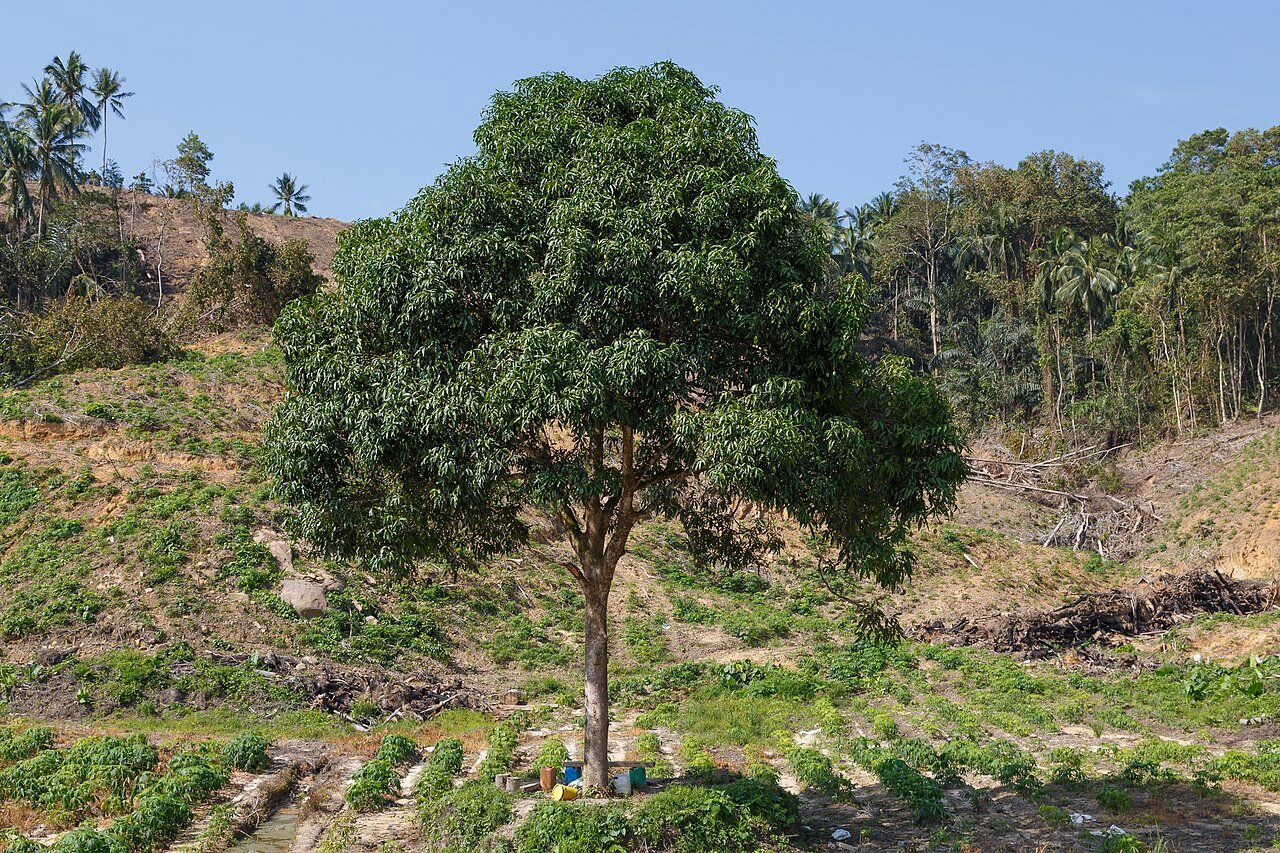
The mango tree is one of the most loved fruit trees in the world, and one of the easiest to identify once you know what to look for. Its long, glossy leaves hang in loose clusters, its flowers arrive in huge cream-coloured clouds in late winter, and its fruit is unmistakable. In South Asia, where the mango is native, the tree is also a familiar part of village life, shading courtyards and marking the seasons.
This guide covers the mango tree in every season: the leaves and bark you can check all year, the flowers of late winter, and the fruit of summer. Whether you are standing under a young orchard tree or a huge old village mango, the same features will confirm it.
Mango Tree Features to Check
Start with the leaves, which are available all year. Mango leaves are long and lance-shaped, usually 15 to 35 centimetres, dark green and glossy above and paler below, with a smooth margin and a pointed tip. Young leaves are often reddish or coppery before they turn green, which is a useful clue in spring. The leaves hang in clusters at the ends of the branches and stay on the tree through the year, because mango is evergreen.
The bark is the second feature. On a young tree it is smooth and grey-brown, but on an older tree it becomes dark grey to almost black, rough, and cracked into small rectangular plates. The trunk is usually short and stout, branching low into a broad, rounded crown that can spread 10 metres or more across. A mature mango tree is often wider than it is tall.
The flowers appear in late winter to early spring, in huge branching clusters called panicles that can hold thousands of tiny cream or pinkish flowers. They have a faint sweet scent and attract many bees. If you see a tree covered in these frothy clusters, with long glossy leaves below, you are almost certainly looking at a mango.
How to Identify It Step by Step
- Look at the leaves: long, glossy, lance-shaped, dark green above, with a smooth margin and a pointed tip. Young leaves may be reddish.
- Check the crown: a broad, rounded, evergreen canopy on a short stout trunk, often wider than the tree is tall.
- Look for the flowers in late winter: huge clusters of tiny cream flowers with a faint sweet scent.
- Check the fruit in summer: large, oval, smooth-skinned, turning yellow-orange as it ripens, with one large flat stone inside.
- Upload a leaf or fruit photo to the Tree Identifier or Fruit Identifier to confirm, and compare the bark with the description above.
Mango Varieties You May Meet
- Chaunsa: a late-season variety from Pakistan with very sweet, aromatic, fibreless flesh and a thin golden skin.
- Sindhri: an early-season variety with large, oval, yellow fruit and a rich sweet flavour, common in Sindh.
- Anwar Ratol: a small, intensely sweet variety with a strong fragrance, ripening in mid-summer.
- Langra: a green-skinned variety that stays green even when ripe, with very sweet pale flesh.
- Dussehri: a medium, sweet variety with a thin skin and a strong mango aroma, popular across northern India and Pakistan.
Common Mistakes to Avoid
- Confusing mango with other evergreen trees that have long leaves, such as lychee or jamun. Check the fruit and the flower clusters to separate them.
- Expecting the leaves to fall in winter. Mango is evergreen, so bare branches in winter mean it is not a mango.
- Judging ripeness by colour alone. Some varieties stay green when ripe, so check softness and scent as well as colour.
- Assuming every large evergreen tree with glossy leaves is a mango. The flower clusters and the single flat stone in the fruit are the decisive clues.
Mango Through the Seasons
A mango tree tells the year in four acts. In late winter the bare-looking branches fill with cream flower clusters. In spring the flowers give way to small green fruit and flushes of reddish young leaves. In summer the fruit swells, colours and ripens, and the tree is at its most generous. In autumn and winter the tree rests, evergreen and quiet, storing energy for the next flowering. Learning these four acts means you can identify a mango in any month, not just in fruit season.
Mango trees can live for a hundred years or more, and an old tree can produce hundreds of kilograms of fruit in a good year. That long life is why old mango trees become landmarks, and why identifying one correctly matters to the people who care for it.
Frequently Asked Questions
How do I identify a mango tree without fruit?
Use the leaves: long, glossy, lance-shaped, dark green above, with a smooth margin. The broad evergreen crown and dark cracked bark on an old tree also help.
What is the scientific name of the mango tree?
Mangifera indica. It belongs to the cashew family, Anacardiaceae, and is native to South Asia.
When does a mango tree flower?
In late winter to early spring. The flowers grow in huge clusters of tiny cream flowers and attract many bees.
How tall does a mango tree grow?
Usually 10 to 20 metres tall, with a broad rounded crown that can spread 10 metres or more across.
Try it yourself: upload a photo to the Tree Identifier and see the identification with full details on this site. Read also: Identify a Tree by Its Fruit.
The mango tree gives you clues in every season: glossy lance-shaped leaves all year, cream flower clusters in late winter, and unmistakable fruit in summer. Learn those three features and the broad evergreen crown, and you will never mistake a mango for another tree again.