
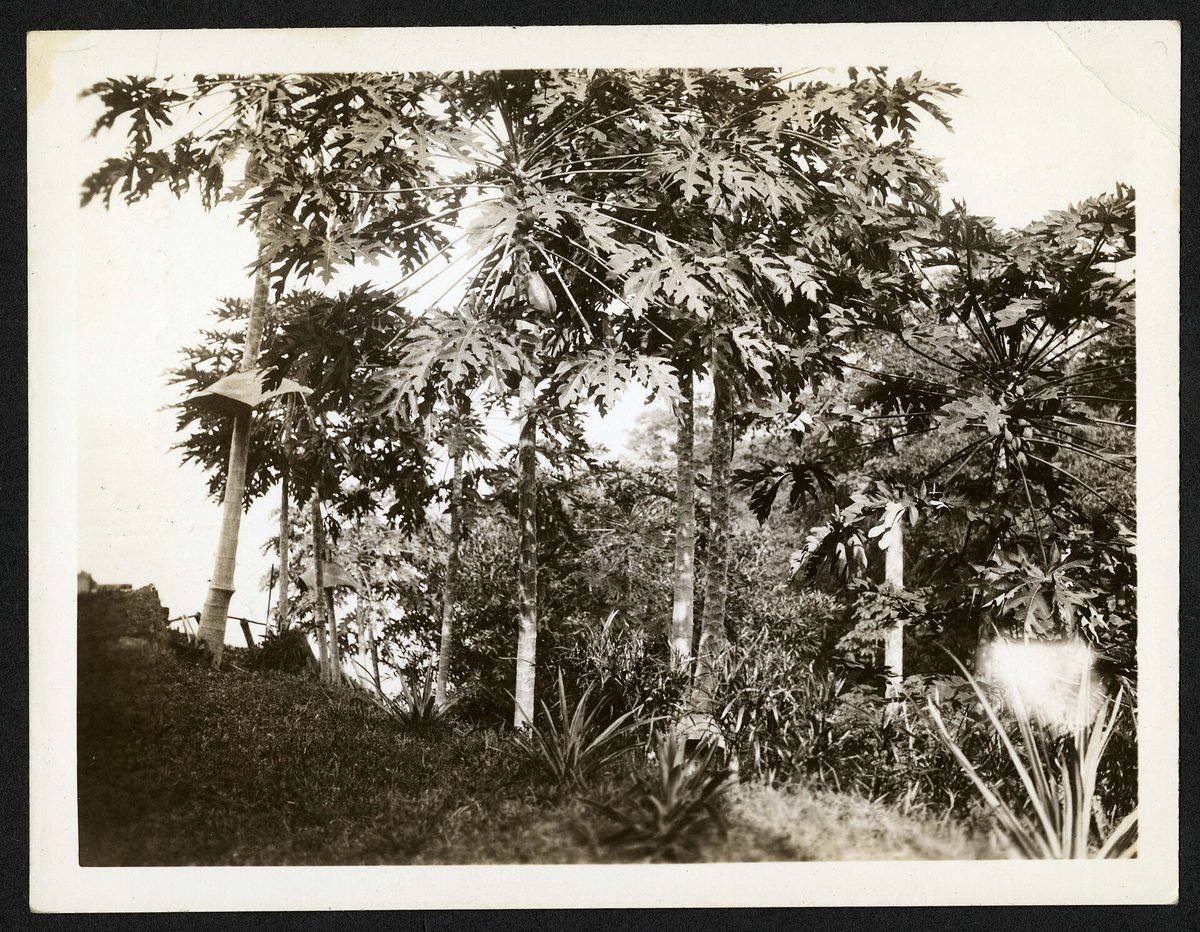
The papaya is one of the most distinctive trees you will ever see. It grows fast, with a single straight trunk topped by a crown of huge lobed leaves, and large fruit that grows directly from the trunk and upper stem rather than from the ends of branches. Once you have seen a papaya, its shape alone is hard to forget.
This guide shows you how to identify a papaya tree, Carica papaya, in every stage of growth. You will learn the look of its trunk, the shape of its leaves, the form of its flowers, and the size and colour of its fruit. With those features checked together, you can separate papaya from every other tropical tree.
Papaya Tree Features to Check
Start with the trunk, which is unlike almost any other tree. The papaya trunk is tall, straight and single, with no woody branches, and it is soft and hollow inside rather than hard like timber. The surface is pale grey-green and marked with rings of large leaf scars where old leaves have fallen away. The trunk can reach 3 to 10 metres tall, and the whole crown sits at the top like an umbrella.
The leaves are the second feature and are very large. Each leaf is 50 to 70 centimetres across, deeply divided into seven to eleven lobes, and carried on a long hollow stalk that can be more than a metre long. The leaves are bright green, smooth and slightly glossy, and they spread out in a spiral at the top of the trunk. Young leaves near the crown are often paler green than the older leaves below them.
The flowers and fruit complete the picture. Papaya flowers are small, white or pale yellow, with five petals, and they grow directly from the trunk and upper stem in the leaf axils. The fruit is large and oval, 15 to 45 centimetres long, with smooth skin that turns from green to yellow-orange as it ripens, and orange flesh inside full of small round black seeds in a hollow centre.
How to Identify It Step by Step
- Look at the whole plant: a single straight trunk with leaf scars, no woody branches, and a crown of huge leaves at the top.
- Check the leaves: very large, deeply lobed into seven to eleven parts, on long hollow stalks that spread from the top of the trunk.
- Look for the fruit: large oval fruit growing directly from the trunk and upper stem, not from the ends of branches.
- Photograph the whole tree from a distance and one leaf flat on a plain background, in daylight, so the shape and size are clear.
- Upload the leaf or fruit photo to the Fruit Identifier, then confirm the result with the trunk scars before you decide.
Papaya Clues at Each Stage
- Young plant: a short single stem with a few huge lobed leaves at the top, already showing the leaf scars on the stem below.
- Flowering: small white or pale yellow five-petalled flowers appear in the leaf axils along the upper trunk.
- Green fruit: large green fruit hangs from the trunk, firm and smooth-skinned, with pale flesh and white seeds inside.
- Ripe fruit: the skin turns yellow-orange, the flesh turns deep orange and sweet, and the black seeds sit in the hollow centre.
- Old tree: a tall leaning trunk with a small crown at the top and many leaf scars, sometimes supported by a stake in a garden.
Common Mistakes to Avoid
- Calling a papaya a palm tree, since both have a single trunk and a crown of large leaves, but a palm has a woody trunk and fronds, not lobed leaves.
- Identifying from the fruit alone, since unripe papaya looks like other green tropical fruit, and the lobed leaves are needed to be sure.
- Expecting branches. A papaya has no woody side branches at all, and a branched tree with similar leaves is a different species.
- Assuming every tall single-stem plant with big leaves is a papaya. Check the leaf scars on the trunk and the fruit on the stem to confirm.
Why Papaya Fruit Grows on the Trunk
Papaya fruit grows directly from the trunk and upper stem because the tree has no woody branches to carry it. The flowers form in the leaf axils along the stem, and the fruit develops there, hanging close to the trunk where the soft stem can support its weight. This growth pattern is called cauliflory, and it is shared by a few other tropical trees, but none of them combines it with huge lobed leaves on long hollow stalks.
The papaya grows very fast, often fruiting within a year of planting, and it lives for only a few years before it grows too tall and is replaced. That short fast life is part of its identification too: a papaya is almost always a young, fast-growing plant in a garden or a warm field, not an ancient forest giant.
Frequently Asked Questions
How do I identify a papaya tree quickly?
Look for a single straight trunk with leaf scars, huge deeply lobed leaves at the top, and large fruit growing from the stem.
What is the scientific name of the papaya tree?
Carica papaya. It belongs to the family Caricaceae and is native to Central America and southern Mexico.
How tall does a papaya tree grow?
Usually 3 to 10 metres tall, with a single trunk and a crown of large lobed leaves at the top.
Can I eat fruit from a tree I identified myself?
No, never eat wild fruit based only on a photo or an app result. Confirm the identification with a local expert before eating any wild fruit.
Try it yourself: upload a photo to the Fruit Identifier and see the identification with full details on this site. Read also: How to Identify a Tree from a Photo.
The papaya tree gives you clear clues at a glance: a single scarred trunk, huge lobed leaves on long stalks, and large fruit growing from the stem. Learn the trunk and the leaf shape first, and the fruit will confirm what you found.