
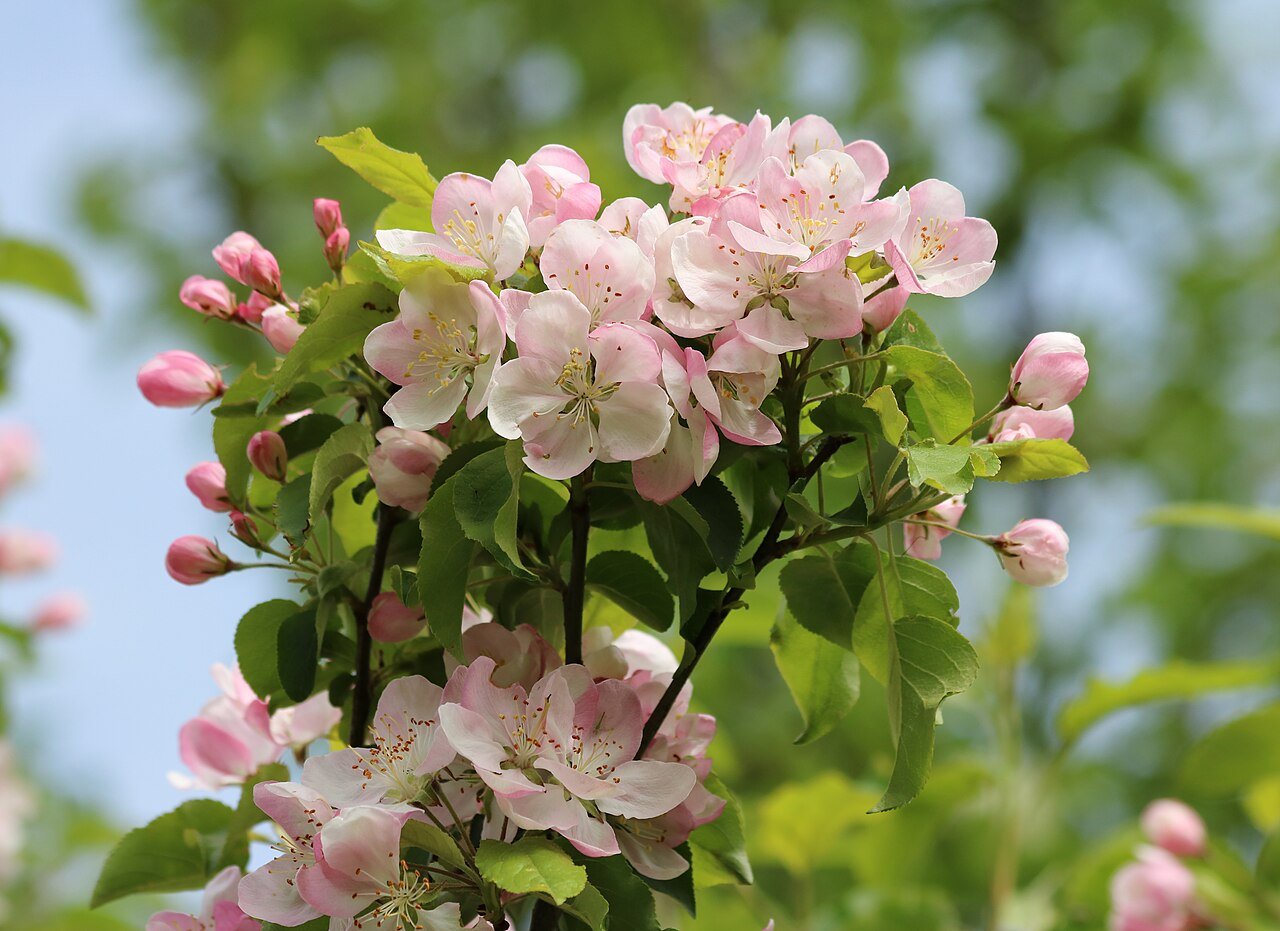
The apple tree is one of the most planted fruit trees in the world, and one of the most rewarding to identify. In spring it covers itself in pink and white blossom, in summer its oval leaves shade the garden, and in autumn it hangs with round fruit that is different for every variety. A single apple tree can feed a family, and its identification is the first step to caring for it well.
This guide explains the blossom, leaves, fruit and bark of the apple tree, how it changes through the seasons, and how to tell it apart from its relatives — pear, cherry and crab apple — which share some of its features.
Apple Tree Features to Check
The blossom is the most beautiful clue. Apple flowers open in spring in clusters of five or six, each with five petals that are white inside and flushed with pink outside, and a soft sweet scent. They open just before or with the leaves, and they are visited by bees from the first warm day. If you see a small tree covered in pink and white five-petalled blossom in spring, apple is the first tree to consider.
The leaves are oval, 5 to 10 centimetres long, with a toothed margin, a pointed tip and a soft, slightly hairy underside. They are arranged alternately along the twig, and they turn yellow in autumn before falling. The leaf stalk is short, and the young leaves are often flushed with bronze before they turn green.
The fruit is the most decisive feature. An apple is round, 5 to 10 centimetres across, with smooth skin in shades of green, yellow or red, and a short stalk set in a shallow hollow. Cut it across and you will find five small brown seeds arranged in a star, in five chambers. That star pattern is unique to apples and their close relatives, and it confirms the identification at once.
How to Identify It Step by Step
- Look for the blossom in spring: clusters of five-petalled flowers, white inside and pink outside, with a sweet scent.
- Check the leaves: oval, toothed, 5 to 10 centimetres long, with a soft hairy underside, arranged alternately.
- Check the fruit in autumn: round, smooth-skinned, with a short stalk, and five seeds in a star when cut across.
- Look at the bark: grey-brown and scaly on older trees, peeling in small plates, on a short trunk with a broad rounded crown.
- Upload a blossom or fruit photo to the Tree Identifier or Fruit Identifier to confirm, and compare the seed pattern with the description above.
Common Apple Varieties
- Golden Delicious: yellow-green fruit with a sweet mild flavour, ripening in autumn, and a spreading tree that crops heavily.
- Red Delicious: deep red, elongated fruit with a sweet flavour and a distinctive five-pointed base.
- Granny Smith: bright green, crisp and tart fruit, excellent for cooking, ripening late in the season.
- Gala: small, sweet, red and yellow striped fruit, popular for eating fresh, ripening in early autumn.
- Fuji: large, sweet, crisp fruit with red and yellow skin, ripening late and storing well.
Common Mistakes to Avoid
- Confusing apple with pear. Pear leaves are glossier and smoother, pear fruit is pear-shaped rather than round, and pear blossom is pure white without the pink flush.
- Confusing apple with cherry. Cherry blossom is similar, but cherry leaves are more pointed and cherry fruit is small with a single stone, not a star of seeds.
- Expecting the fruit to look like a shop apple. Garden and wild apples vary in size, colour and shape, and a small sour apple is still an apple.
- Judging by blossom alone. Several fruit trees have pink and white blossom, so always check the leaves and the fruit as well.
Caring for an Apple Tree
An apple tree needs full sun, well-drained soil and a cold winter to set fruit well. Prune in late winter, while the tree is dormant, to keep the centre open to light and air — a crowded tree produces small fruit and invites disease. Thin the young fruit in early summer, leaving one apple per cluster, and the remaining fruit will grow larger and sweeter.
Most apple trees need another apple variety nearby for pollination, because a single tree cannot fertilise itself. If your tree flowers well but sets little fruit, a neighbour tree or a second variety may be the answer. Bees do the work, so avoid spraying insecticide while the tree is in blossom.
Frequently Asked Questions
How do I identify an apple tree?
Look for pink-white five-petalled blossom in spring, oval toothed leaves, round fruit with five seeds in a star, and scaly grey-brown bark.
What is the scientific name of the apple tree?
Malus domestica. It belongs to the rose family, Rosaceae, and was domesticated from wild apples in Central Asia.
What is the difference between an apple and a pear tree?
Apple fruit is round with a star of five seeds; pear fruit is pear-shaped with a gritty texture. Apple blossom is pink-flushed, pear blossom is pure white.
When do apple trees produce fruit?
Apples ripen from late summer to late autumn, depending on the variety. Early varieties ripen in August, late varieties in October.
Try it yourself: upload a photo to the Tree Identifier and see the identification with full details on this site. Read also: Citrus Tree Identification Guide.
The apple tree tells its story in four seasons: pink blossom in spring, green leaves in summer, round fruit in autumn, and scaly bark in winter. Learn the blossom, the toothed leaves and the star of seeds inside the fruit, and you will recognise an apple tree in any garden, orchard or hedgerow.