
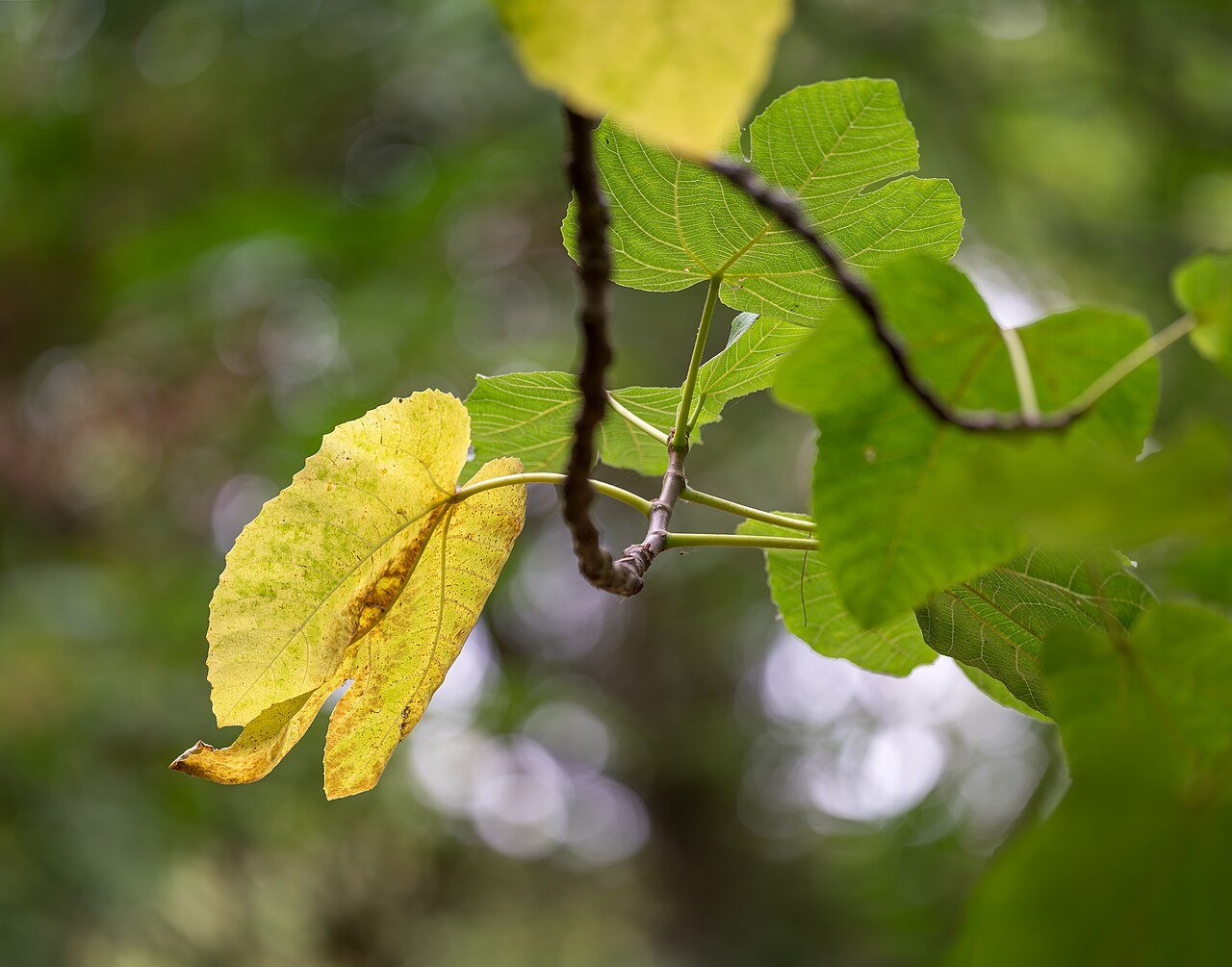
The fig is one of the oldest cultivated fruit trees in the world, grown for its sweet soft fruit for thousands of years around the Mediterranean and the Middle East. Its large lobed leaves are unmistakable, its milky sap is a clue you can see as well as feel, and its fruit — soft, sweet and full of tiny seeds — is unlike any other.
This guide explains the leaves, sap, bark and fruit of the fig tree, how it grows, and how to tell it apart from other trees with lobed leaves, such as mulberry and grapevine.
Fig Tree Features to Check
The leaves are the fastest clue. Fig leaves are large, 10 to 25 centimetres across, with three to five deep lobes, a rough texture and a long stalk. They are dark green above and paler below, and they feel slightly rough to the touch. The lobes are broad and rounded, not pointed, which separates fig from grapevine, whose leaves are more sharply lobed, and from mulberry, whose leaves are smaller and smoother.
The milky sap is the second feature. Break a leaf stalk or a young twig and a white milky sap appears at once. That sap is a hallmark of the fig family, and it is also an irritant: it can sting the skin and it can burn in sunlight, so wash your hands after handling it and keep it away from your eyes. The sap is a useful clue, but it is one to check carefully.
The fruit is the third feature. Figs are soft, pear-shaped fruit, 3 to 6 centimetres long, with thin skin in shades of green, purple or black, and soft pink-red flesh full of tiny seeds. They grow singly in the leaf axils, ripening in summer, and they are very sweet when fully ripe. The bark is smooth and grey on young trees, becoming rougher with age, on a short trunk with a broad spreading crown.
How to Identify It Step by Step
- Look at the leaves: large, 10 to 25 centimetres, with three to five broad rounded lobes and a rough texture, on a long stalk.
- Check for milky sap: break a leaf stalk and look for white sap. Wash your hands afterwards and keep it away from your eyes.
- Look for the fruit in summer: soft, pear-shaped figs with thin skin and pink-red flesh full of tiny seeds.
- Check the bark: smooth and grey when young, rougher with age, on a short trunk with a broad spreading crown.
- Upload a leaf or fruit photo to the Tree Identifier or Fruit Identifier to confirm, and compare the lobe shape with the description above.
Fig Varieties and Relatives
- Brown Turkey: a hardy variety with large purple-brown fruit, sweet flesh, and a spreading tree that crops heavily.
- Black Mission: dark purple-black fruit with very sweet red flesh, a popular variety for eating fresh and drying.
- Kadota: green-skinned fruit with amber flesh, excellent for drying and preserving, on a vigorous tree.
- Banyan: a fig relative with oval leaves and aerial roots, a huge tree that is not grown for its small fruit.
- Mulberry: has smaller, smoother leaves and produces small clustered berries, not the soft pear-shaped fruit of a fig.
Common Mistakes to Avoid
- Confusing fig with grapevine. Both have lobed leaves, but grapevine is a climber with tendrils, while fig is a tree with milky sap.
- Handling the milky sap carelessly. Fig sap irritates the skin and can burn in sunlight, so wash your hands after touching a broken leaf stalk.
- Picking figs too early. Unripe figs are hard and tasteless; a ripe fig is soft, slightly drooping, and often splits at the base.
- Expecting figs to have visible flowers. Fig flowers are tiny and hidden inside the fruit, so a fig tree never shows a showy blossom.
Growing Figs
Figs are among the easiest fruit trees to grow. They need full sun, well-drained soil and very little care once established, and they tolerate drought and poor soil. They fruit on new growth, so prune in late winter to encourage fresh shoots, and restrict the roots if you want more fruit and less leaf — a fig in a pot often fruits better than a fig in open ground.
A fig tree can live for decades and produce two crops a year in warm climates: an early crop on last year's wood and a main crop on new growth. That generosity is why figs are planted in gardens all over the warm world, and why identifying one correctly is the first step to enjoying its fruit.
Frequently Asked Questions
How do I identify a fig tree?
Look for large lobed leaves, white milky sap from a broken stalk, smooth grey bark, and soft pear-shaped fruit with pink-red flesh.
What is the scientific name of the fig tree?
Ficus carica. It belongs to the fig family, Moraceae, and is native to the Middle East and the Mediterranean.
Is fig sap dangerous?
Fig sap irritates the skin and can burn in sunlight. Wash your hands after handling it and keep it away from your eyes.
When do figs ripen?
Figs ripen in summer, and in warm climates a second crop follows in autumn. A ripe fig is soft, slightly drooping and sweet.
Try it yourself: upload a photo to the Tree Identifier and see the identification with full details on this site. Read also: Banyan Tree Identification Guide.
The fig tree is easy to know: large lobed leaves, milky sap, smooth grey bark and soft sweet fruit. Learn those features, handle the sap with care, and you will recognise a fig tree in any garden — and you will know when its fruit is ready to eat.