
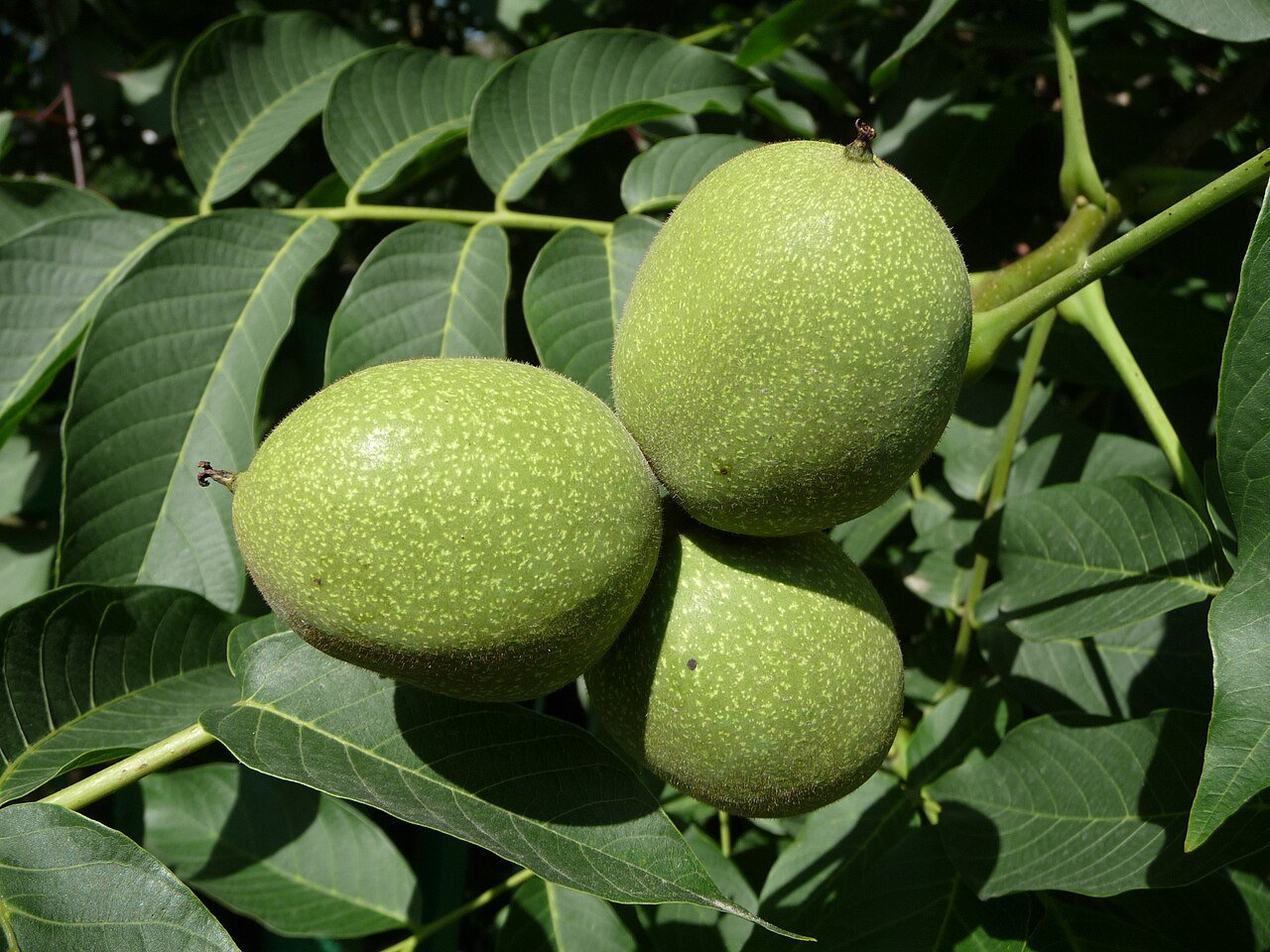
The walnut is a tree of two gifts: its nuts are among the most nutritious foods in the world, and its timber is among the most beautiful. A mature walnut is a large, handsome tree with a broad rounded crown, large compound leaves that smell faintly of citrus when crushed, and round green fruit that splits open in autumn to reveal the hard wrinkled shell inside.
This guide explains the leaves, fruit, bark and shape of the walnut tree, how it differs from other nut trees, and why it needs space and patience — a walnut takes years to fruit, but it repays the wait for generations.
Walnut Tree Features to Check
The leaves are the fastest clue. Walnut leaves are compound and pinnate, 30 to 60 centimetres long, with 5 to 9 large oval leaflets on one stalk. The leaflets are smooth-edged, pointed, and dark green, and the whole leaf has a faint citrus scent when crushed. The leaves appear late in spring — walnut is one of the last trees to leaf — and they turn yellow in autumn before falling.
The fruit is the second feature. Walnuts grow in round green husks, 4 to 5 centimetres across, which split open in autumn to reveal a hard, light-brown, wrinkled shell. Inside the shell is the kernel, shaped like a tiny brain, rich in oil and flavour. The husks stain the hands dark brown, so wear gloves when you handle them, and note that the stain is itself a clue.
The bark and shape are the third feature. Walnut bark is dark grey-brown, thick and deeply furrowed into a diamond pattern on older trees. The trunk is short and massive, branching into a broad, rounded, open crown that can spread 15 metres or more. A mature walnut can reach 25 metres tall and live for more than a century.
How to Identify It Step by Step
- Look at the leaves: large compound leaves, 30 to 60 centimetres, with 5 to 9 smooth oval leaflets. Crush one and check for a faint citrus scent.
- Check the fruit in autumn: round green husks that split open to reveal a hard wrinkled shell with a brain-shaped kernel inside.
- Look at the bark: dark grey-brown, thick and deeply furrowed in a diamond pattern on older trees.
- Step back and look at the crown: broad, rounded and open, on a short massive trunk, often wider than the tree is tall.
- Upload a leaf or fruit photo to the Tree Identifier or Fruit Identifier to confirm, and compare the leaflet count with the description above.
Walnut Varieties and Relatives
- English walnut: the common eating walnut, with a thin shell, sweet kernel, and a broad spreading tree; the variety grown in orchards.
- Black walnut: a North American species with a very hard dark shell, strongly flavoured kernel, and dark, almost black bark.
- Butternut: a relative with longer, more pointed nuts and a lighter shell, sometimes called the white walnut.
- Pecan: a walnut relative with longer compound leaves and smooth oval nuts in a thin shell, grown in warm climates.
- Hickory: a close relative with similar compound leaves, but its nuts are smaller and its bark peels in long shaggy strips.
Common Mistakes to Avoid
- Confusing walnut with ash. Both have compound leaves, but ash leaflets are toothed and its seeds are winged, while walnut leaflets are smooth and its fruit is a round husk.
- Expecting leaves in early spring. Walnut is late to leaf, and a bare walnut in early spring is normal, not dead.
- Handling the green husks without gloves. Walnut husks stain skin dark brown for days, and the stain is hard to wash off.
- Planting a walnut too close to other plants. Walnut roots release a chemical that inhibits many plants, so give a walnut plenty of space.
Growing Walnuts
Walnuts need deep, well-drained soil, full sun and space — a mature tree needs at least 10 metres in every direction. They are slow to fruit, often taking 7 to 10 years from planting, but a mature tree can produce 50 kilograms of nuts a year for decades. Grafted varieties fruit earlier and more reliably than seedlings, so buy a grafted tree if you want nuts sooner.
The timber is as valuable as the nuts: walnut wood is dark, richly figured and easy to work, and it is used for furniture, gunstocks and veneer. A walnut you plant today may feed your family and furnish a house for the next generation.
Frequently Asked Questions
How do I identify a walnut tree?
Look for large compound leaves with 5 to 9 smooth leaflets, round green husks that split in autumn, a hard wrinkled shell, and dark furrowed bark.
What is the scientific name of the walnut tree?
Juglans regia, the English or Persian walnut. It belongs to the walnut family, Juglandaceae.
When do walnuts ripen?
Walnuts ripen in autumn, when the green husks split open and the nuts fall to the ground.
Why do walnut husks stain hands?
The husks contain juglone, a dark compound that stains skin brown. Wear gloves when handling green walnuts.
Try it yourself: upload a photo to the Tree Identifier and see the identification with full details on this site. Read also: Oak Tree Identification Guide.
The walnut tree is easy to know: large compound leaves, round green husks, hard wrinkled shells and dark furrowed bark. Learn those features, give the tree space and time, and you will recognise a walnut anywhere — and you will understand why it is valued for both its nuts and its timber.