
Sometimes the bird is the hardest part of bird identification to see. It may be hidden in a hedge, out feeding, or simply too quick to follow. But the nest it leaves behind is a lasting record, and its eggs are often distinctive enough to narrow the owner down to a small group of species.
This guide covers the main nest types, the materials birds use, the colours and sizes of common garden bird eggs, and the rules that protect nesting birds. The first rule is always the same: never disturb an active nest.
Nest Shapes: Cups, Domes, Cavities and Platforms
Most garden birds build open cup nests: a neat bowl of twigs, grass and moss, often lined with hair or feathers, tucked into a hedge or tree fork. Blackbirds build a classic cup nest, strengthened with mud, while robins build a similar cup but often choose a sheltered nook, bank, shed or even an old kettle. Song thrushes line their cup with a smooth layer of mud, a useful clue when you find an old nest.
Other birds build differently. Tits and other cavity nesters use holes in trees or nest boxes, filling them with moss, hair and feathers. Wrens build a domed nest with a side entrance, hidden low in a bank or hedge. Wood pigeons build a flimsy platform of twigs, so loose that the eggs can sometimes be seen through it from below. Learning these shapes is the first step: nest architecture is often as distinctive as the bird.
Egg Colour, Size and Clutch
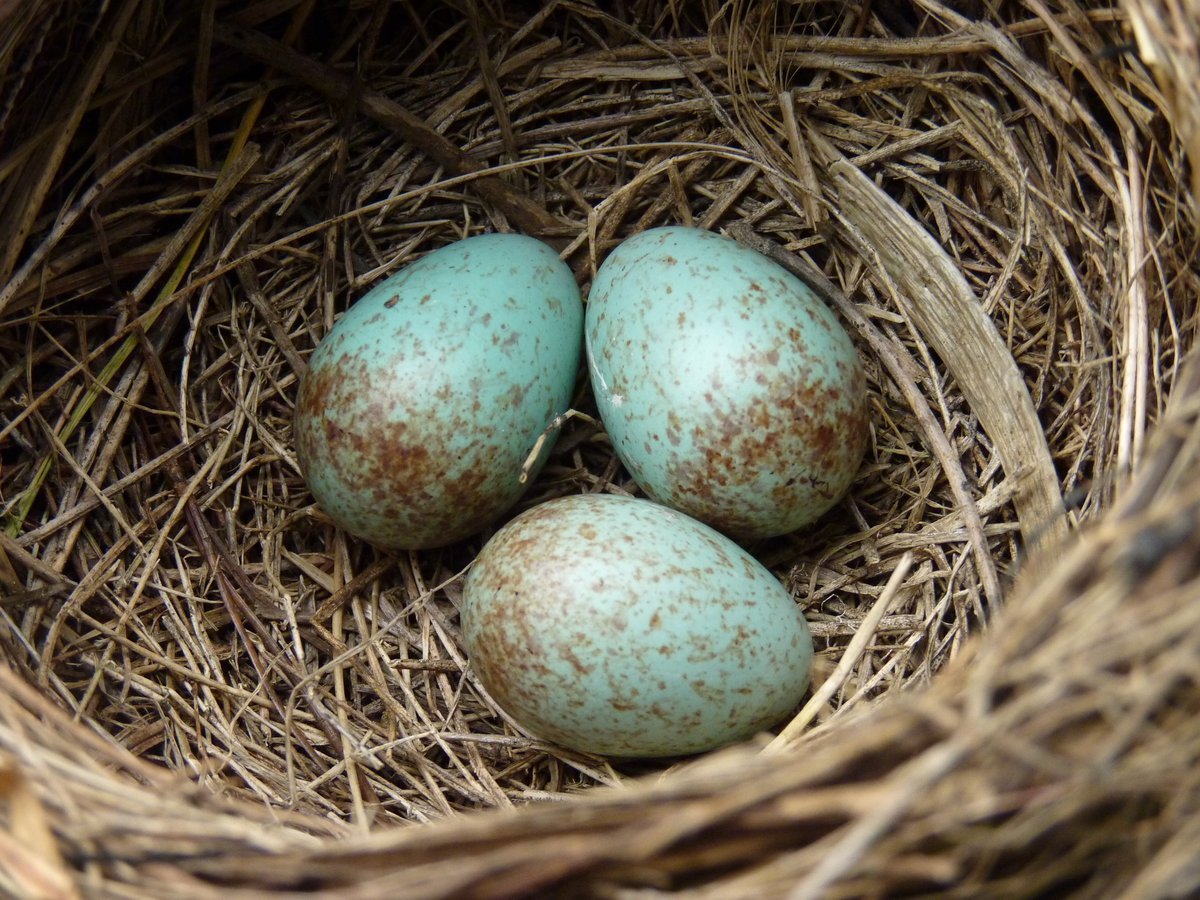
Egg colour is a powerful clue. Blackbirds lay blue-green eggs with brown speckles, usually three to five in a clutch, each egg around 2.9 by 2.1 centimetres. Robins lay white to cream eggs with light brown speckles, usually four or five, each about 2 by 1.5 centimetres. Blue tits lay small white eggs with fine reddish speckles, often in clutches of seven or more.
Size matters as much as colour, because it reflects the size of the bird. A small egg in a small nest belongs to a small bird, and a large egg in a large nest belongs to a larger one. Note the background colour, speckle pattern and number of eggs, and compare them with a guide. Never handle eggs or remove them: in many countries it is illegal to disturb nesting birds, and even a brief visit can cause a parent to abandon the nest.
Where to Look, and How to Watch Safely
The best time to study nests is outside the breeding season, when old nests can be examined without risk to birds. In winter, look in bare hedges and shrubs for the remains of cup nests, and check nest boxes after the season has ended. During the breeding season, watch from a distance with binoculars, and note which birds carry material or food to one spot.
Signs of an active nest include birds carrying food repeatedly to one place, alarm calls when you approach, and droppings or feathers beneath a hedge. If you see these signs, enjoy the discovery from a distance. Keep dogs on a lead near hedges in spring, and avoid trimming hedges during the breeding season, because many nests are hidden in the branches.
How to Identify a Bird from Its Nest in 5 Steps
Use these steps only on old, empty nests, or from a safe distance.
- Note the location. Is it in a tree fork, a hedge, a cavity, a nest box or a building? The site alone rules out many species.
- Describe the shape. Is it an open cup, a dome, a platform or a cavity filling? Measure it roughly and note the materials.
- Look at the lining. Is it lined with mud, moss, hair or feathers? Smooth mud points towards a thrush, moss and feather towards a tit.
- Record the eggs. From a distance, note the colour, speckles, size and number of eggs, and compare them with a guide. Use the tree identifier tool to learn the trees the nest is built in.
- Watch the parents. The surest identification is the bird itself. Watch quietly from a distance and note which species visits.
Quick Clues Checklist
- Neat cup of twigs and mud in a hedge: blackbird.
- Smooth mud-lined cup: song thrush.
- Cup in a sheltered nook or shed: robin.
- Moss and feathers in a hole or nest box: blue tit or great tit.
- Domed nest with a side entrance, low down: wren.
- Flimsy platform of twigs in a tree: wood pigeon.
Common Mistakes to Avoid
- Disturbing an active nest. It is illegal in many countries, and it can cause parents to abandon their eggs or chicks.
- Handling eggs or chicks. Never touch eggs or young birds: your scent and presence can attract predators and stress the parents.
- Identifying by egg colour alone. Several species lay similar eggs, so combine colour with nest shape, location and the birds nearby.
- Assuming an empty nest is abandoned. Parents may be away feeding, and a nest that looks empty may still be active, so treat every nest as occupied.
- Trimming hedges in spring. Many nests are hidden in hedges, so avoid cutting them in the breeding season.
Frequently Asked Questions
Is it illegal to disturb a bird's nest?
In many countries, including the United Kingdom, it is illegal to disturb nesting birds or to take or damage their eggs.
What colour are blackbird eggs?
Blackbird eggs are blue-green with brown speckles. A clutch usually has three to five eggs, each about 2.9 by 2.1 centimetres, laid in a neat cup nest of twigs and mud.
How can I tell a robin's nest from a blackbird's nest?
Both are cup nests, but robins often choose sheltered nooks in banks, sheds or walls, while blackbirds prefer hedges and shrubs. Robin eggs are white to cream with light brown speckles; blackbird eggs are blue-green.
When is the best time to look for old nests?
Winter is best. When the leaves have fallen, old nests are easy to spot in bare hedges and shrubs.
Nests and eggs open a quieter kind of birdwatching, one that rewards careful observers who respect the birds. Learn the shapes, materials and egg colours, and always put the birds' welfare first. To learn more about the trees and shrubs birds nest in, read our guide to identifying a tree by its leaves, and use the tree identifier tool to check them.
Featured image: Wikimedia Commons (CC / public domain).